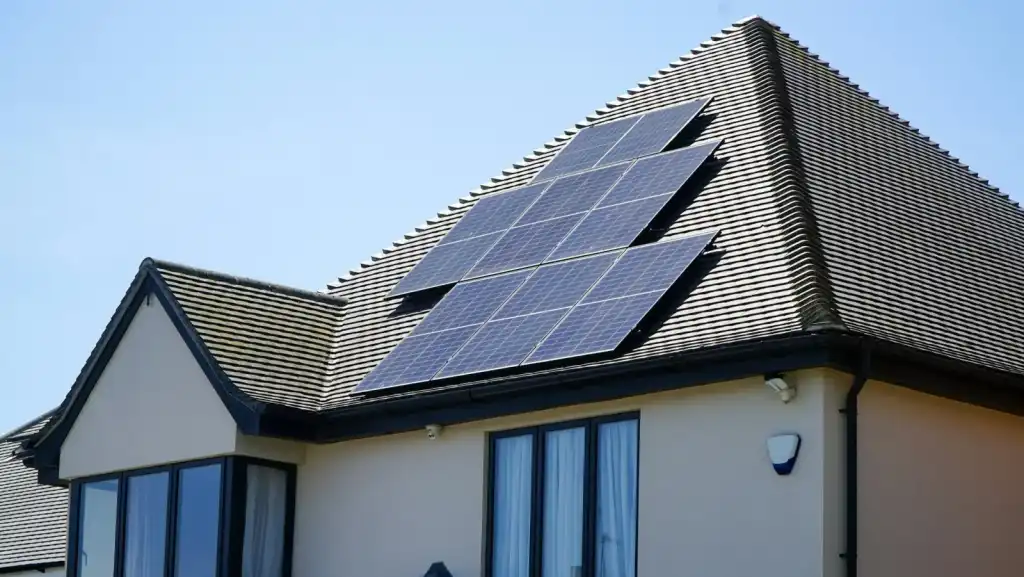
Off-grid solar
Size it for December. Then it works all year.
Solar data updated · How we calculate this
Your loads, your state
Your use
2.7 kWh a day
Solar panels
1,250 W
About 4 × 400 W panels. In December, 1 kW of panels in Baltimore makes about 2.20 kWh a day.
Battery bank
9.7 kWh
2.7 kWh × 3 days ÷ 85% usable.
Sized for December, the darkest month. The rest of the year you will have spare power. The US Department of Energy also advises a backup generator for long cloudy spells.
Kits you can buy for this
Complete kits from each brand's own store: the power station, batteries and that brand's own panels. One button puts every item in the brand's cart; you review and check out on their site. Prices checked Oct 26, 2026 and they change.
Disclosure: We may earn a commission if you buy through these links. It never changes our recommendations. How we make money.
- Recommended · Covers it for the least
Bluetti Apex 300 + B300K + 700 W solar
120/240 V home-style system you can grow to 19 kWh
What's in the cart
- 1 ×Apex 300 (2,764.8 Wh) + B300K battery (2,764.8 Wh) + two 350 W solar panels, Bluetti bundle (opens in a new tab)$3,698
- 2 ×BLUETTI B300K expansion battery for Apex 300 (2,764.8 Wh) (opens in a new tab)$2,158
Add a batteryBLUETTI B300K expansion battery for Apex 300 (2,764.8 Wh), $1,079 each. Up to 5 (Bluetti: the Apex 300 takes up to six B300K batteries).
- Battery: 3.4 days of your use
- Panels: 56% of December need
- Runs it all at once: yes
- 120/240 V
In December the panels make about 56% of a day's use; the battery covers the gap until it runs low.
Total, 3 items$5,85611 kWh battery · 700 W of panels
Add this kit to your cart at Bluetti (opens in a new tab)Opens Bluetti's own cart with all 3 items. You check out on their site. Prices checked Oct 26, 2026.
- Another brand that covers it
Jackery Explorer 5000 Plus + 1,000 W solar
120/240 V and 7,200 W output, for well pumps and home circuits
What's in the cart
- 1 ×Explorer 5000 Plus (5,040 Wh) + two SolarSaga 500 X panels, Jackery bundle (opens in a new tab)$4,639
- 1 ×Jackery Battery Pack 5000 Plus (5,040 Wh) (opens in a new tab)$2,599
Add a batteryJackery Battery Pack 5000 Plus (5,040 Wh), $2,599 each. Up to 1 (Jackery sells the 5000 Plus as a 10 kWh set with one Battery Pack 5000 Plus; we offer no more than that).
- Battery: 3.1 days of your use
- Panels: 80% of December need
- Runs it all at once: yes
- 120/240 V
In December the panels make about 80% of a day's use; the battery covers the gap until it runs low.
Total, 2 items$7,23810 kWh battery · 1,000 W of panels
Add this kit to your cart at Jackery (opens in a new tab)Opens Jackery's own cart with all 2 items. You check out on their site. Prices checked Oct 26, 2026.
Jackery's product description says up to 4,000 W input in its solar section.
- Another brand that covers it
EcoFlow DELTA Pro 3 + 2 Extra Batteries + 800 W solar
The DELTA Pro 3 at its full 12.3 kWh
What's in the cart
- 1 ×DELTA Pro 3 (4,096 Wh) + two Smart Extra Batteries (4,096 Wh each), EcoFlow bundle (opens in a new tab)$6,169
- 1 ×Two EcoFlow 400 W portable solar panels (2-pack) (opens in a new tab)$1,099
- Battery: 3.8 days of your use
- Panels: 64% of December need
- Runs it all at once: yes
- 120/240 V
In December the panels make about 64% of a day's use; the battery covers the gap until it runs low.
Total, 2 items$7,26812 kWh battery · 800 W of panels
Add this kit to your cart at EcoFlow (opens in a new tab)Opens EcoFlow's own cart with all 2 items. You check out on their site. Prices checked Oct 26, 2026.
Add all items to the cart at Bluetti: https://www.awin1.com/cread.php?awinmid=59271&awinaffid=3125360&ued=https%3A%2F%2Fwww.bluettipower.com%2Fcart%2F47354165887195%3A1%2C47262756896987%3A2%3Fstorefront%3Dtrue
How the calculation works
Daily use (Wh) = watts × hours a day, added up for everything you run. That is the US Department of Energy's method. For fridges, freezers, TVs and microwaves we use the average yearly use from the EIA's 2020 household survey, divided by 365, because they cycle on and off.
Panel watts = daily use ÷ December kWh per kW per day.The December figure is the PVWatts model's output for 1 kW of south-facing panels at a 20 degree tilt near the city shown for each state, already net of 14% system losses and 96% inverter efficiency. We divide the December total by 31 days.
Battery = daily use × days with little sun ÷ usable share. We count 85% of a lithium battery's rated capacity as usable (the same figure we use across the site for power stations) and 50% for lead-acid AGM, the depth Renogy rates its AGM battery at.
For vans and RVs, see Camper Volts.
Off-grid solar size in every state
The essentials (2.7 kWh a day: a fridge, Wi-Fi, four LED bulbs for 5 hours and two phone charges), sized for December with 3 days of lithium storage. Weakest winter sun first.
| State | Modeled near | December kWh per kW a day | Panels | Battery |
|---|---|---|---|---|
| Alaska | Anchorage | 0.23 | 12.0 kW | 9.7 kWh |
| Washington | Seattle | 1.13 | 2,430 W | 9.7 kWh |
| Oregon | Portland | 1.26 | 2,170 W | 9.7 kWh |
| Vermont | Burlington | 1.45 | 1,890 W | 9.7 kWh |
| Michigan | Detroit | 1.46 | 1,890 W | 9.7 kWh |
| Wisconsin | Milwaukee | 1.55 | 1,770 W | 9.7 kWh |
| Idaho | Boise | 1.67 | 1,640 W | 9.7 kWh |
| Minnesota | Minneapolis | 1.69 | 1,630 W | 9.7 kWh |
| North Dakota | Fargo | 1.72 | 1,600 W | 9.7 kWh |
| Illinois | Chicago | 1.83 | 1,500 W | 9.7 kWh |
| Ohio | Columbus | 1.84 | 1,500 W | 9.7 kWh |
| Indiana | Indianapolis | 1.85 | 1,480 W | 9.7 kWh |
| Connecticut | Bridgeport | 1.90 | 1,450 W | 9.7 kWh |
| West Virginia | Charleston | 1.94 | 1,420 W | 9.7 kWh |
| Maine | Portland | 1.95 | 1,410 W | 9.7 kWh |
| Montana | Billings | 1.96 | 1,400 W | 9.7 kWh |
| Kentucky | Louisville | 2.00 | 1,370 W | 9.7 kWh |
| Rhode Island | Providence | 2.00 | 1,370 W | 9.7 kWh |
| New Jersey | Newark | 2.04 | 1,350 W | 9.7 kWh |
| New York | New York City | 2.05 | 1,340 W | 9.7 kWh |
| New Hampshire | Manchester | 2.06 | 1,330 W | 9.7 kWh |
| Massachusetts | Boston | 2.08 | 1,320 W | 9.7 kWh |
| South Dakota | Sioux Falls | 2.13 | 1,290 W | 9.7 kWh |
| Pennsylvania | Philadelphia | 2.18 | 1,260 W | 9.7 kWh |
| Delaware | Wilmington | 2.18 | 1,260 W | 9.7 kWh |
| Maryland | Baltimore | 2.20 | 1,250 W | 9.7 kWh |
| Iowa | Des Moines | 2.21 | 1,250 W | 9.7 kWh |
| Tennessee | Nashville | 2.32 | 1,190 W | 9.7 kWh |
| Nebraska | Omaha | 2.33 | 1,180 W | 9.7 kWh |
| District of Columbia | Washington | 2.37 | 1,160 W | 9.7 kWh |
| Virginia | Virginia Beach | 2.49 | 1,100 W | 9.7 kWh |
| Utah | Salt Lake City | 2.50 | 1,100 W | 9.7 kWh |
| Missouri | Kansas City | 2.51 | 1,100 W | 9.7 kWh |
| Alabama | Birmingham | 2.55 | 1,080 W | 9.7 kWh |
| Georgia | Atlanta | 2.56 | 1,070 W | 9.7 kWh |
| Arkansas | Little Rock | 2.61 | 1,050 W | 9.7 kWh |
| North Carolina | Charlotte | 2.64 | 1,040 W | 9.7 kWh |
| Mississippi | Jackson | 2.72 | 1,010 W | 9.7 kWh |
| South Carolina | Charleston | 2.75 | 1,000 W | 9.7 kWh |
| Wyoming | Cheyenne | 2.77 | 990 W | 9.7 kWh |
| Texas | Houston | 2.90 | 950 W | 9.7 kWh |
| Kansas | Wichita | 2.93 | 940 W | 9.7 kWh |
| Louisiana | New Orleans | 2.96 | 930 W | 9.7 kWh |
| Florida | Jacksonville | 3.00 | 920 W | 9.7 kWh |
| Oklahoma | Oklahoma City | 3.04 | 910 W | 9.7 kWh |
| Colorado | Denver | 3.08 | 890 W | 9.7 kWh |
| California | Los Angeles | 3.42 | 800 W | 9.7 kWh |
| Nevada | Las Vegas | 3.42 | 800 W | 9.7 kWh |
| Arizona | Phoenix | 3.57 | 770 W | 9.7 kWh |
| New Mexico | Albuquerque | 3.70 | 740 W | 9.7 kWh |
| Hawaii | Honolulu | 4.05 | 680 W | 9.7 kWh |
What to do with the numbers
Under about 1,000 W of panels and a few kWh of battery, an all-in-one portable power station with solar input can do the job. See what size cabin solar kit you need. Bigger than that, you are looking at a component system with a separate inverter and battery bank, plus a backup generator, as the US Department of Energy advises.
Comparing that with the cost of bringing in a power line? See how to go off grid.
Frequently asked questions
How do I size an off-grid solar system?
Add up the watt-hours you use in a day (watts × hours for each appliance, the US Department of Energy method). Divide by what 1 kW of panels makes in a December day where you live to get panel watts. Then multiply the daily use by the days you want to ride through with little sun and divide by the share of the battery you can use (85% for lithium) to get battery size. Our calculator does all three with PVWatts output for your state.
Why size for December instead of the yearly average?
An off-grid system has no grid to fall back on, so it must keep up in the darkest month. December is the lowest-output month in our PVWatts model in all 50 states and DC (in West Virginia January ties it). In Maryland, 1 kW of panels makes about 2.20 kWh a day in December, only 47% of what it makes in June. Size for the yearly average and the batteries run flat every winter.
How many solar panels do I need to run a fridge off grid?
A typical US fridge uses about 2.3 kWh a day (EIA: 839 kWh a year). In Maryland in December that takes about 1,040 W of panels, or 3 panels of 400 W. In Alaska, with the weakest December sun, it takes about 10.0 kW.
How many days of battery storage do I need off grid?
There is no single rule. The US Department of Energy advises sizing batteries for cloudy stretches and keeping a backup generator. We start at 3 days. Pick more if your winters bring long runs of cloud, fewer if you have a generator you are happy to run.
Can I use lead-acid batteries off grid?
Yes, but you need a bigger bank. Renogy rates its AGM deep-cycle battery at 50% depth of discharge, against the 85% of rated capacity we count as usable for lithium. So the same days of storage take about 1.7 times the rated capacity in AGM.
Estimates only. Real output depends on your exact site, panel angle, shade, snow and equipment. Size a real system with an installer or an off-grid supplier before you buy. See our disclaimer.
Sources
- PVWatts v8 solar model (National Laboratory of the Rockies, formerly NREL, run via its PySAM package) on NASA POWER hourly weather — monthly output per kW by state, average of 2015-2024 hourly weather; 1 kW DC fixed roof mount, 20 degree tilt, facing south (180 degrees), standard module, 14% system losses, 96% inverter efficiency, DC/AC ratio 1.2 (PVWatts defaults except tilt). Checked against the PVWatts web API for eight states: within 8%, 3% on average.
- PVWatts v8 API documentation (National Laboratory of the Rockies) — monthly AC output; 14% system losses
- US DOE Energy Saver, Estimating appliance and home electronic energy use (archived copy) — watts × hours a day ÷ 1,000 = kWh a day
- US DOE Energy Saver, Balance-of-system equipment for renewable energy systems (archived copy) — balance-of-system equipment (batteries, controllers, inverters, wiring) could be half of a stand-alone system's cost; size batteries for cloudy weather, with a backup generator
- EIA Residential Energy Consumption Survey 2020, table CE4.6.EL.ST — refrigerators: 839 kWh a year per household
- EIA Residential Energy Consumption Survey 2020, table CE5.3b (detailed electricity end use) — separate freezers 570 kWh, most-used TV 210 kWh, microwaves 107 kWh a year per household
- Eugene Water & Electric Board, Generator sizing considerations — running and starting watts: well pump 1/3 HP 1,000 W (+2,000 W to start), furnace fan blower 1/3 HP 700 W (+1,400), refrigerator/freezer 700 W (+2,200), microwave 1,000 W, laptop 60 W, phone charger 20 W
- US DOE Energy Saver, Energy efficient lighting fact sheet (2021) — a 1,100-lumen LED screw-in bulb uses as little as 9 W
- EnergySage, How many watts does a Wi-Fi router use? — 5 to 20 W; we use 10 W
- TidBITS, iPhone battery-life tables — iPhone 16 battery 13.84 Wh; we use 15 Wh a charge to allow for charging losses
- ResMed battery guide (AirSense 10) — 28 W with heated humidifier, about 11 W without
- Dometic CFX3 35 specifications — 0.98 Ah an hour at 12 V on a 90°F day
- Renogy Deep Cycle AGM Battery 12V 100Ah product page — rated at 50% depth of discharge
Keep going
- Cabin solar kit sizeWeekend, part-time or full-time, by state
- How to go off gridPower line cost vs solar and battery, step by step
- Power outage backup calculatorFridge, CPAP, well pump and furnace through an outage
- Generator runtime and fuelHow much fuel to store, and how to run it safely
- Emergency water storageGallons to store for your household
- How to purify waterBleach drops, boiling and filters
- Emergency water filtersFilters and purifiers by certification
- Emergency kit checklistWhat a 72-hour and 2-week kit needs
- Emergency food calculatorCalories to store, not servings
- NOAA weather radioFind your station and county code
Photo: Watt A Lot on Unsplash (Unsplash License).