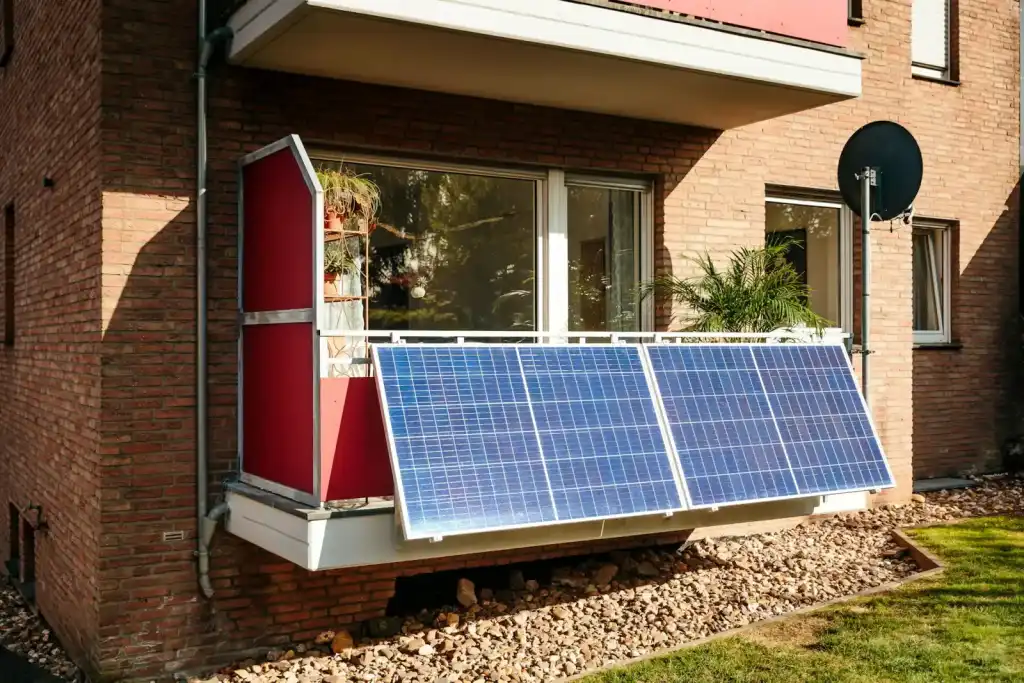
Plug-in solar
Solar for everyone. Just plug it in.
Laws checked against state legislature sites on .
Disclosure: We may earn a commission if you buy through these links. It never changes our recommendations. How we make money.
$186/yr
Off your bill, typical state
An 800 W kit on a stand in South Carolina, if you use what it makes
9 years
To pay for itself
The $1,595 kit below; 3 years in Hawaii
From $414
To get started
Smallest kit we list, at the seller's price
Our picks
Our pick for most people
PluggedSolar 800 W Plug-in & Balcony Solar Kit (APsystems)
800 W fits under every state's cap, the seller lists the UL 3700 plug-in safety standard, and the app shows what you're making. In a sunny state it can knock $170 a year off your bill.
- Up to $170 a year in Utah
- Covers your fridge and Wi-Fi in daylight
- Moves with you
- No installer
Our pick on a budget
Bright Saver Balcony Solar Kit 360 W
The cheapest way in, from the nonprofit behind many of the state plug-in solar laws. It only ships to states with a law, so you know it's allowed where it lands.
*Price on the seller's site when we checked on October 15, 2026.
How it works, in plain English
A plug-in kit is one to four solar panels, usually 400 to 1,200 watts in total, wired to a microinverterthat turns the panels' direct current into household alternating current in step with the grid. You plug it into an outdoor or balcony outlet. Its power flows into that circuit and is used first by whatever is running in your home: the fridge, router, TV and other appliances that are always on. You buy less from the utility while the sun is up.
The inverter is the safety-critical part. A listed one stops sending power within moments if the grid goes down, so the plug's pins are never live when unplugged and it cannot feed lines a utility worker is repairing. That also means a kit with no battery gives no backup power during an outage.
Germany has made these kits common, but in the US connecting any generator to your home's wiring has traditionally needed a utility interconnection agreement. The new state laws exempt small kits from that process.
What it's worth where you live
We ran the PVWatts solar model from the National Laboratory of the Rockies (formerly NREL) on ten years of hourly NASA weather for a large city in every state, for an 800 W kit mounted three ways:
- On a stand, facing south, 30° tilt: the best case, like a ground stand or flat roof.
- Flat on a south-facing railing or wall: a typical balcony.
- Flat on an east- or west-facing railing: the average of east and west.
In Utah, the first state with a law, an 800 W kit on a stand makes about 1,293 kWh a year (108a month on average), against an average Utah home's 774 kWh a month. Shade from railings, trees or the floor above can cut output sharply; the model assumes none.
| Jan | 74 kWh |
|---|---|
| Feb | 86 kWh |
| Mar | 112 kWh |
| Apr | 120 kWh |
| May | 122 kWh |
| Jun | 133 kWh |
| Jul | 134 kWh |
| Aug | 128 kWh |
| Sep | 122 kWh |
| Oct | 110 kWh |
| Nov | 84 kWh |
| Dec | 69 kWh |
| State | kWh/yr, stand | kWh/yr, south railing | kWh/yr, east/west railing | Value/yr (stand) | Payback at $1,595 |
|---|---|---|---|---|---|
| Alabama | 1,105 | 679 | 533 | $183 | 8.7 yrs |
| Alaska | 703 | 548 | 390 | $190 | 8.4 yrs |
| Arizona | 1,459 | 873 | 703 | $225 | 7.1 yrs |
| Arkansas | 1,101 | 686 | 532 | $150 | 10.6 yrs |
| California | 1,461 | 873 | 712 | $486 | 3.3 yrs |
| Colorado | 1,328 | 906 | 632 | $222 | 7.2 yrs |
| Connecticut | 1,039 | 696 | 499 | $290 | 5.5 yrs |
| Delaware | 1,081 | 719 | 520 | $193 | 8.3 yrs |
| District of Columbia | 1,087 | 722 | 517 | $268 | 6.0 yrs |
| Florida | 1,155 | 670 | 555 | $177 | 9.0 yrs |
| Georgia | 1,095 | 674 | 531 | $169 | 9.5 yrs |
| Hawaii | 1,369 | 668 | 678 | $633 | 2.5 yrs |
| Idaho | 1,181 | 785 | 586 | $153 | 10.4 yrs |
| Illinois | 1,038 | 695 | 505 | $199 | 8.0 yrs |
| Indiana | 1,019 | 665 | 500 | $174 | 9.2 yrs |
| Iowa | 1,112 | 760 | 535 | $158 | 10.1 yrs |
| Kansas | 1,234 | 807 | 587 | $188 | 8.5 yrs |
| Kentucky | 1,014 | 652 | 499 | $145 | 11.0 yrs |
| Louisiana | 1,123 | 657 | 543 | $150 | 10.6 yrs |
| Maine | 1,060 | 744 | 507 | $318 | 5.0 yrs |
| Maryland | 1,073 | 709 | 517 | $229 | 7.0 yrs |
| Massachusetts | 1,040 | 723 | 503 | $313 | 5.1 yrs |
| Michigan | 973 | 643 | 487 | $209 | 7.6 yrs |
| Minnesota | 1,064 | 755 | 518 | $173 | 9.2 yrs |
| Mississippi | 1,125 | 671 | 545 | $171 | 9.3 yrs |
| Missouri | 1,132 | 749 | 541 | $158 | 10.1 yrs |
| Montana | 1,141 | 815 | 552 | $159 | 10.0 yrs |
| Nebraska | 1,136 | 774 | 545 | $147 | 10.9 yrs |
| Nevada | 1,448 | 915 | 699 | $196 | 8.1 yrs |
| New Hampshire | 1,039 | 730 | 503 | $278 | 5.7 yrs |
| New Jersey | 1,043 | 706 | 503 | $250 | 6.4 yrs |
| New Mexico | 1,445 | 912 | 697 | $218 | 7.3 yrs |
| New York | 1,059 | 714 | 509 | $311 | 5.1 yrs |
| North Carolina | 1,132 | 716 | 542 | $169 | 9.4 yrs |
| North Dakota | 1,111 | 809 | 539 | $137 | 11.6 yrs |
| Ohio | 1,019 | 669 | 495 | $191 | 8.4 yrs |
| Oklahoma | 1,236 | 781 | 590 | $168 | 9.5 yrs |
| Oregon | 998 | 670 | 502 | $154 | 10.4 yrs |
| Pennsylvania | 1,081 | 721 | 520 | $227 | 7.0 yrs |
| Rhode Island | 1,072 | 727 | 513 | $313 | 5.1 yrs |
| South Carolina | 1,169 | 696 | 557 | $186 | 8.6 yrs |
| South Dakota | 1,137 | 798 | 548 | $165 | 9.7 yrs |
| Tennessee | 1,071 | 675 | 519 | $149 | 10.7 yrs |
| Texas | 1,096 | 630 | 539 | $176 | 9.1 yrs |
| Utah | 1,293 | 858 | 643 | $170 | 9.4 yrs |
| Vermont | 954 | 659 | 468 | $229 | 7.0 yrs |
| Virginia | 1,129 | 713 | 527 | $190 | 8.4 yrs |
| Washington | 946 | 656 | 479 | $136 | 11.7 yrs |
| West Virginia | 1,001 | 645 | 489 | $155 | 10.3 yrs |
| Wisconsin | 1,001 | 676 | 478 | $190 | 8.4 yrs |
| Wyoming | 1,270 | 875 | 609 | $177 | 9.0 yrs |
Value multiplies output by each state's average residential price (July 2026 YTD (year to date); latest month July 2026). It is an upper bound: it assumes every kWh replaces one you would have bought. Payback uses the PluggedSolar 800 W Plug-in & Balcony Solar Kit (APsystems) at $1,595 and ignores mounts, shipping and any rate changes.
What it costs, and how fast it pays you back
Kits we found on US sellers' sites cost from $1.15 to $2.25 per watt of panels. Installed rooftop solar averages $2.60 per watt nationally (EnergySage Marketplace national average before incentives, a typical 12 kW system at $31,135), with no 30% federal credit for homeowners since the end of 2025. So per watt, plug-in solar is similar or cheaper, but it is a small system: it trims a bill rather than replacing it.
The catch is self-consumption.A kit only saves money on power you use while it is producing. Most homes draw a few hundred watts around the clock (fridge, freezer, router, standby loads), so a 400 W kit is mostly used at home, but at midday an 800 to 1,200 W kit can out-produce that base load. The surplus flows to the grid. Vermont's law says it is not paid for, Versant Power in Maine says the same, and in Connecticut it can even be billed as usage on meters that cannot net meter. A zero-export controller (some kits include one) or a battery fixes that by holding back or storing the surplus.
Rule of thumb: size the kit to your daytime base load. Check it on your smart meter or utility app at midday when nobody is cooking or running the dryer.
Safe by design: what to look for
- Stay at or under 1,200 W (1,920 W in Colorado). A standard 15-amp, 120-volt circuit is rated for 1,800 W. Solar entering at an outlet can let appliances on that circuit draw more than the breaker sees, so the caps keep the wiring within its rating. Maine requires a dedicated circuit above 420 W.
- One kit, one wall outlet. Plug straight into a wall outlet, ideally a GFCI-protected outdoor one. No power strips, extension cords or adapters.
- A listed inverter with anti-islanding (it must shut off in a power cut). Look for the certifications below on the product, not just the website.
- Secure mounting.Panels on a balcony act like sails; use the maker's brackets and check your lease or HOA rules (several new laws limit bans but allow reasonable rules).
- UL 3700
- UL Solutions began certifying plug-in solar equipment to UL 3700 (an "outline of investigation" for interactive plug-in PV) on January 8, 2026. It tests overload protection, shock and ground-fault safety, and that the kit cannot push power into the house wiring during an outage. Maine and Vermont name it in law. Source
- UL 1741 and IEEE 1547
- The long-standing inverter standards. A listed microinverter shuts off within moments of losing grid power ("anti-islanding"), so it cannot energize lines a utility worker is repairing. Connecticut's law requires both. Source
- National Electrical Code (NFPA 70)
- According to UL Solutions, the 2026 NEC, like earlier editions, does not recognize solar that feeds a home through an ordinary receptacle. State laws exempt these kits from utility interconnection rules, but local building and electrical codes can still apply. Source
Plug-in solar laws by state (as of October 15, 2026)
Utah went first, in 2025. In 2026, 9more states followed. Each law works the same way: it exempts small kits from the utility interconnection rules that otherwise apply to anything that sends power into your home's wiring. The details differ: wattage caps, whether you must notify the utility, which certification counts, and when it takes effect. Rules for leases, HOAs and local permits vary too.
No law in your state? Then the normal rule applies: ask your utility before connecting anything. Bills have been introduced in other states; we list only bills we could confirm on a legislature website. Laws are summarized, not quoted; read the linked text and check with your utility.
- CaliforniaLaw from January 1, 2027 · 1,200 W max
From January 1, 2027, devices up to 1,200 W per home with certified outage shut-off are exempt from interconnection rules until 2030. Utilities cannot charge fees but may require a simple online registration. Until then, utilities expect an interconnection application.
SB 868. Signed September 30, 2026 (Chapter 985); takes effect January 1, 2027.
- ColoradoLaw in effect · 1,920 W max
One lab-listed device per address, up to 1,920 W, needs no utility approval, fee or extra equipment; the utility may ask you to tell it the device's size. From 2027, unlisted devices over 391 W cannot be sold and HOA bans are void.
HB26-1007. Signed May 7, 2026; in effect since August 12, 2026.
- ConnecticutLaw in effect · 1,200 W max
One device per meter, up to 1,200 W into a 120 V outlet, meeting UL 1741 and IEEE 1547, needs no interconnection agreement or approval. On a meter that cannot net meter, power you send out can be billed as if you used it.
HB 5340. Signed June 4, 2026 (Public Act 26-127); in effect since October 1, 2026.
- MaineLaw in effect · 1,200 W max
Kits certified to UL 3700 (or comparable) are allowed up to 1,200 W. Up to 420 W per address you can install yourself; 420 to 1,200 W needs a licensed electrician, a dedicated circuit and notice to the utility within 30 days.
LD 1730. Signed April 6, 2026 (Public Law 2025, c. 644).
- MarylandLaw in effect · 1,200 W max
One UL-certified system per meter, up to 1,200 W, at homes only. You must notify the utility and certify the safety features; the utility cannot require approval or extra equipment, and the system earns no renewable energy credits.
HB 1532. Signed May 12, 2026 (Chapter 353); in effect since July 1, 2026.
- New HampshireLaw from January 1, 2027 · 1,200 W max
From January 1, 2027, one lab-certified system per meter, up to 1,200 W, needs no utility approval or interconnection review; the utility may only ask you to report the wattage afterwards.
SB 540. Signed July 2, 2026 (Chapter 262); takes effect January 1, 2027.
- New JerseyLaw from March 1, 2027 · 1,200 W max
Devices up to 1,200 W into a standard 120 V outlet will be exempt from utility interconnection approval, fees and local permits, and landlords and HOAs cannot broadly ban them. Check the final certification rules before buying.
S2368 / A4836. Signed September 1, 2026; the governor's office says it takes effect March 1, 2027.
- New YorkBill pending · 1,200 W max
Would let listed devices up to 1,200 W skip utility approval, with online notice to the utility within 30 days.
S8512C / A9111C. Passed both chambers May 28, 2026; not yet signed by the governor.
- UtahLaw in effect · 1,200 W max
Kits up to 1,200 W that plug into a standard 120 V outlet, are certified by UL or an equivalent lab and shut off in a power outage need no interconnection agreement, utility approval, fee or extra equipment. They are not part of net metering.
HB 340. Signed March 2025; in effect since May 7, 2025.
- VermontLaw in effect · 1,200 W max
Up to 1,200 W per meter, certified to UL 3700 and IEEE 1547-2018, on homes with smart meters. No approval or fees, but no net metering either: exported power is not paid for.
S.202. Signed June 16, 2026 (Act 149); in effect since July 1, 2026.
- VirginiaLaw from January 1, 2027 · 1,200 W max
From January 1, 2027, certified kits up to 1,200 W per customer need no utility approval or fees, but you must file a notification form before installing. Larger landlords cannot ban them outright.
HB 395 / SB 250. Signed April 22, 2026; takes effect January 1, 2027.
No plug-in solar law yet: check with your utility
Alabama, Alaska, Arizona, Arkansas, Delaware, District of Columbia, Florida, Georgia, Hawaii, Idaho, Illinois, Indiana, Iowa, Kansas, Kentucky, Louisiana, Massachusetts, Michigan, Minnesota, Mississippi, Missouri, Montana, Nebraska, Nevada, New Mexico, North Carolina, North Dakota, Ohio, Oklahoma, Oregon, Pennsylvania, Rhode Island, South Carolina, South Dakota, Tennessee, Texas, Washington, West Virginia, Wisconsin, Wyoming
The kits you can buy in the US
These are 120-volt kits listed for sale to US addresses on the seller's own website, with prices checked on October 15, 2026. We list what each seller states about certification; check that a kit meets the standard your state's law names before you buy (for example UL 3700 in Maine and Vermont).
Bright Saver
Balcony Solar Kit 360 W
Up to $92 a year off a typical US bill, paying for itself in about 5 years.
- Sold at member price by Bright Saver, the nonprofit behind many state plug-in solar bills; a 180 W kit is $285.30.
- Uses a Hoymiles microinverter. Ships only to states with a plug-in solar law (listed on its page).
- Bright Saver says to plug it into a GFCI-protected outlet.
Specs
- Panels included
- 360 W
- Inverter output
- 360 W
- Battery
- None
- Certifications stated
- UL 1741 (inverter), UL 3700 subassembly certification (inverter)
- Price per watt
- $1.15
- Sold for
- UT, VA, CO, MD, CT, NH, NJ only
EcoFlow
STREAM Microinverter + 400 W panel
Up to $102 a year off a typical US bill, paying for itself in about 8 years.
- Inverter alone is $369 if you already have panels.
- EcoFlow's page says plug-in installation is currently permitted in Utah, Maryland, Connecticut and Colorado.
- No UL 3700 listing stated on the product page.
Specs
- Panels included
- 400 W
- Inverter output
- 1,200 W
- Battery
- None
- Certifications stated
- UL 1741
- Price per watt
- $2.00
- Sold for
- UT, MD, CT, CO only
PluggedSolar
800 W Plug-in & Balcony Solar Kit (APsystems)
Up to $204 a year off a typical US bill, paying for itself in about 8 years.
- Four 200 W panels with an APsystems 800 W microinverter and Wi-Fi monitoring; mounts not included at this price.
- Also sold as 400 W ($1,195), 1,200 W ($2,390) and 1,600 W ($3,190) kits.
Specs
- Panels included
- 800 W
- Inverter output
- 800 W
- Battery
- None
- Certifications stated
- UL 1741, UL 3700 (claimed by seller)
- Price per watt
- $1.99
CraftStrom
1200 W Eco-Line Plug&Play Solar
Up to $306 a year off a typical US bill, paying for itself in about 7 years.
- Three 400 W inverters. Houston-based seller.
- The seller says it is available in all 50 states with no permits needed; that is not what state law says, so check the rules for your state first.
Specs
- Panels included
- 1,200 W
- Inverter output
- 1,200 W
- Battery
- None
- Certifications stated
- UL-certified inverter (seller's claim)
- Price per watt
- $1.88
Mango Power
Mango Power S 1,200 W Plug-In Solar Kit
Up to $306 a year off a typical US bill, paying for itself in about 9 years.
- Includes panels, stand, cables and a zero-export gateway that stops power flowing out to the grid.
- Four microinverters with a 25-year warranty, per Mango Power.
- Trade press reports UL 3700 certification through Intertek; the product page does not say so.
Specs
- Panels included
- 1,200 W
- Inverter output
- 1,200 W
- Battery
- None
- Certifications stated
- UL 1741-SA/SB, IEEE 1547:2018, CA Rule 21
- Price per watt
- $2.25
*Prices from each seller's US website on October 15, 2026; they change often. Bright Saver's price is its member price. Not listed: Anker's Solarbank, Bluetti's Balco, Jackery's balcony systems and Zendure's SolarFlow 800 and 2400, which are sold in Europe but not in US stores; Zendure's US SolarFlow kit was sold out.
Want power in a blackout too? Add a battery
A battery stores midday surplus for the evening, which is where most of the extra savings come from. In Europe, all-in-one balcony batteries are common; in the US the choice is thin right now. EcoFlow's US store lists the STREAM microinverter, but its STREAM Ultra battery page was not available when we checked; Zendure's US SolarFlow kit was sold out; and CraftStrom's 2 kW + 3 kWh set ($8,199) has more panel power than any state's cap allows.
The option that is legal everywhere:a portable power station with its own solar panels. It doesn't feed your home's wiring, so no utility approval is needed. You plug the fridge or a home office into it, it charges from the sun, and unlike a grid-tied kit it keeps working in a blackout. Compare portable power stations or see whole-home battery options.
Frequently asked questions
Is plug-in solar legal in the US?
It depends on the state. As of October 15, 2026, 10 states have passed laws that let small plug-in solar kits connect without a utility interconnection agreement: Utah, Maine, Colorado, Maryland, Connecticut, Vermont (in effect) and Virginia, New Hampshire, New Jersey, California (taking effect in 2027). New York has passed a bill that is not yet signed. Everywhere else, connecting any panel that feeds your home's wiring normally needs your utility's approval, so check with your utility first.
How much electricity does an 800 W plug-in solar kit produce?
Between about 703 and 1,461 kWh a year on a south-facing stand, depending on the state, in our PVWatts model on ten years of NASA weather. Hung flat on a south-facing railing it makes roughly a third less, and on an east- or west-facing railing about half as much. The average US home uses about 10,360 kWh a year, so a kit covers a small slice of the bill.
How long does plug-in solar take to pay for itself?
For an 800 W kit costing $1,595, simple payback ranges from about 3 years in Hawaii to about 12 years in Washington at average electricity prices, and only if you use every kWh it makes at the moment it makes it. Power your home doesn't use flows to the grid, usually for no credit, so real payback is longer unless your daytime use is steady or the kit has a battery.
Can I plug a solar panel into any outlet?
Only a kit built for it: a listed microinverter that shuts off instantly when the grid goes down, plugged straight into a wall outlet (not a power strip or extension cord), ideally a GFCI-protected one on a circuit with little else running. Most state laws cap kits at 1,200 W because a standard 15-amp circuit is rated for 1,800 W and the solar adds to what the wiring carries. Never use a homemade 'suicide cord' setup.
Do I need to tell my utility?
In some law states, yes: Virginia requires a notice form before you install, Maryland requires notice and a safety certification, Maine requires notice within 30 days above 420 W, and Colorado, New Hampshire and California let the utility ask for a simple notice or registration. Utah's law requires no notice. In states without a law, ask your utility before connecting anything.
Is a portable power station with solar panels the same thing?
No. A power station charges from its own panels and you plug appliances into it; nothing feeds back into your home's wiring, so no utility approval is needed in any state. It also gives you backup in an outage, which a plug-in kit without a battery cannot, because a grid-tied kit shuts off when the grid does.
This is a summary of state laws and seller claims, not legal or electrical advice. Laws, utility rules and prices change; read the linked law, ask your utility, and follow the kit maker's instructions. See our disclaimer.
Sources
- Utah HB 340 — Signed March 2025; in effect since May 7, 2025
- Maine LD 1730 — Signed April 6, 2026 (Public Law 2025, c. 644)
- Virginia HB 395 / SB 250 — Signed April 22, 2026; takes effect January 1, 2027
- Colorado HB26-1007 — Signed May 7, 2026; in effect since August 12, 2026
- Maryland HB 1532 — Signed May 12, 2026 (Chapter 353); in effect since July 1, 2026
- Connecticut HB 5340 — Signed June 4, 2026 (Public Act 26-127); in effect since October 1, 2026
- Vermont S.202 — Signed June 16, 2026 (Act 149); in effect since July 1, 2026
- New Hampshire SB 540 — Signed July 2, 2026 (Chapter 262); takes effect January 1, 2027
- New Jersey S2368 / A4836 — Signed September 1, 2026; the governor's office says it takes effect March 1, 2027
- California SB 868 — Signed September 30, 2026 (Chapter 985); takes effect January 1, 2027
- New York S8512C / A9111C — Passed both chambers May 28, 2026; not yet signed by the governor
- UL 3700
- UL 1741 and IEEE 1547
- National Electrical Code (NFPA 70)
- Versant Power (Maine): balcony solar guidance — No bill credit for exported power
- PVWatts v8 solar model (National Laboratory of the Rockies, formerly NREL, run via its PySAM package) on NASA POWER hourly weather — Same model, run for plug-in mounting positions (scripts/plugin_solar_model.py)
- U.S. Energy Information Administration, Electric Power Monthly, Tables 5.6.A and 5.6.B — July 2026 YTD (year to date); latest month July 2026
- EnergySage: solar panel cost — $2.60/W national average
- EcoFlow STREAM Microinverter + 400 W panel product page — checked October 15, 2026
- Bright Saver Balcony Solar Kit 360 W product page — checked October 15, 2026
- PluggedSolar 800 W Plug-in & Balcony Solar Kit (APsystems) product page — checked October 15, 2026
- CraftStrom 1200 W Eco-Line Plug&Play Solar product page — checked October 15, 2026
- Mango Power Mango Power S 1,200 W Plug-In Solar Kit product page — checked October 15, 2026
Keep going
Photo: Yuma Solar on Unsplash (Unsplash License).