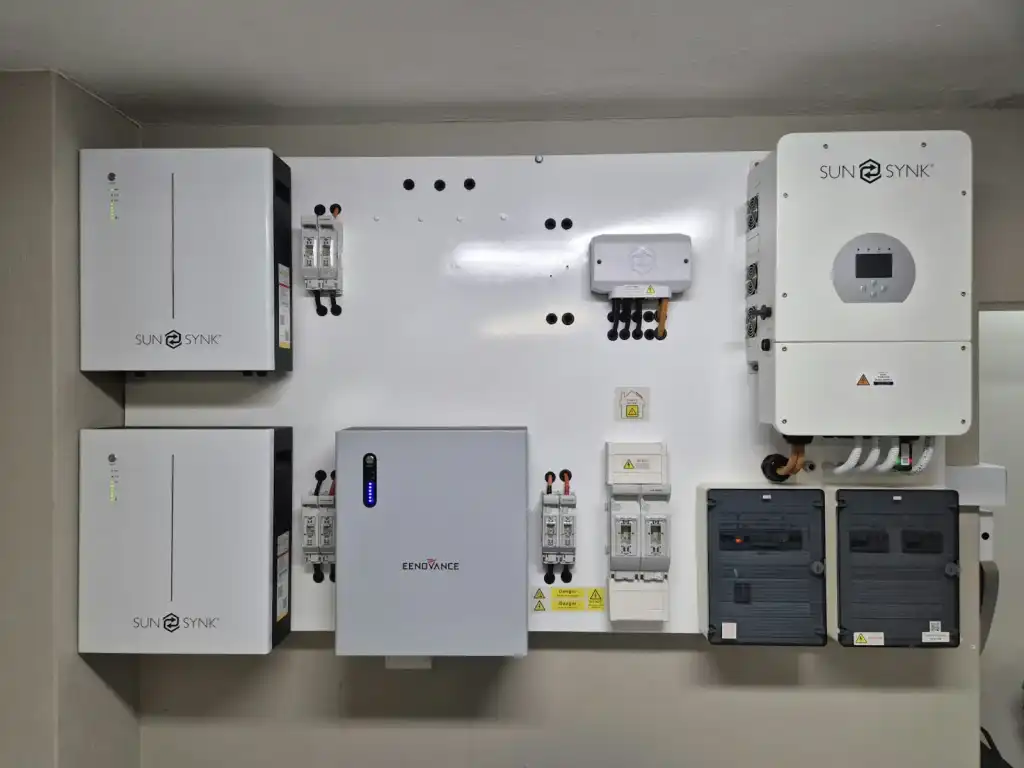
Off-grid guide
Off grid, on purpose. Know the numbers first.
Updated · Solar data from October 15, 2026
Power line or solar and battery?
The US Department of Energy puts a power line extension at $15,000 to $50,000 per mile. Your utility's quote is the real number.
| Distance to the grid | Line extension cost |
|---|---|
| 0.25 miles | $3,750 to $12,500 |
| 0.5 miles | $7,500 to $25,000 |
| 1 mile | $15,000 to $50,000 |
| 2 miles | $30,000 to $100,000 |
| Off grid in Maryland | Panels | Battery | Installed estimate |
|---|---|---|---|
| Part-time cabin3.7 kWh a day | 1,660 W | 13 kWh | $18,900 |
| Full-time home11 kWh a day | 4,920 W | 38 kWh | $56,000 |
Estimate = panel watts × $2.60 a watt + battery kWh × $1,130per kWh: EnergySage's national installed averages for grid-tied systems. Off-grid quotes differ, and a backup generator is extra. Maryland is the state with the middle December sun in our model; sunnier states need fewer panels.
How to go off grid, step by step
- List your loads. Watts × hours a day for everything you will run, added up. In our example full-time home, the fridge, freezer, well pump and furnace blower are most of the total. Our off-grid solar calculator has typical figures.
- Shrink them. Every watt-hour you cut saves panels and battery. Propane or wood for heat, hot water and cooking keeps the biggest loads off the system.
- Size for December.Off grid there is no utility to cover a dark month. Use your state's winter solar output, not the yearly average.
- Pick days of storage, and a backup. The US Department of Energy advises sizing batteries for cloudy weather and keeping a backup generator. See the generator fuel calculator.
- Get the line quote. Ask the utility what it would charge to connect. Compare it with your solar and battery quotes.
- Check permits. Ask your county building department about electrical and building permits, and zoning, before you buy equipment.
- Plan water and waste. A well needs a pump, and the pump needs power: about 1,000 W while it runs for a 1/3 HP pump (EWEB). Private well water is not regulated under the federal Safe Drinking Water Act, so testing is up to you (EPA). For a septic system, check with your county or state health department.
For vans and RVs, see Camper Volts.
Before you cut the cord
If the grid is already at your door, you can keep the connection and add a battery for outages instead. See the power outage backup calculator and home battery backup.
Off grid also means planning water, food and communication for storms. Start with the emergency kit checklist and water storage calculator.
Frequently asked questions
How much does it cost to go off grid?
For a full-time home in Maryland using about 11 kWh a day, sized for December with 3 days of battery, about 4,920 W of panels and 38 kWh of battery. At EnergySage's national installed averages ($2.60 a watt for solar, $1,130 per kWh for batteries) that is roughly $56,000, before a backup generator. Those averages are for grid-tied systems, so get off-grid quotes.
Is it cheaper to go off grid or run a power line?
It depends on the distance. The US Department of Energy says extending a power line can cost $15,000 to $50,000 per mile. On our full-time home estimate of about $56,000, solar and batteries come out cheaper once the line is longer than roughly 1.1 to 3.7 miles. Ask your utility for a written line extension quote; it is the number that decides it.
What is the first step to going off grid?
Write down everything you will run and for how long each day, then add up the watt-hours. That number sets the size of everything else. Cutting it, with LED lights, an efficient fridge and propane or wood for heat and cooking, is the cheapest way to shrink the system.
Do I need a generator if I go off grid?
It is wise. The US Department of Energy recommends sizing batteries for cloudy weather and using a backup generator for the slumps. A generator lets you buy a smaller battery bank and covers long stormy spells.
Do I need a permit to go off grid?
Usually some. Rules are local: check with your county building department about electrical and building permits, and your county or state health department about a well and a septic system, before you buy land or equipment.
Estimates only. Costs depend on your site, distance, local labor and equipment. Get written quotes from your utility and installers. This is general information, not financial or legal advice. See our disclaimer.
Sources
- US DOE Energy Saver, Grid-connected or stand-alone renewable energy systems (archived copy) — extending a power line can cost $15,000 to $50,000 per mile
- US DOE Energy Saver, Balance-of-system equipment for renewable energy systems (archived copy) — balance-of-system equipment (batteries, controllers, inverters, wiring) could be half of a stand-alone system's cost; size batteries for cloudy weather, with a backup generator
- EnergySage Marketplace national average before incentives — $2.60 per watt installed
- EnergySage's home battery price of $1,130 per kWh (first half of 2026) — $1,130 per kWh installed
- PVWatts v8 solar model (National Laboratory of the Rockies, formerly NREL, run via its PySAM package) on NASA POWER hourly weather — monthly output per kW by state, average of 2015-2024 hourly weather; 1 kW DC fixed roof mount, 20 degree tilt, facing south (180 degrees), standard module, 14% system losses, 96% inverter efficiency, DC/AC ratio 1.2 (PVWatts defaults except tilt). Checked against the PVWatts web API for eight states: within 8%, 3% on average.
- US DOE Energy Saver, Estimating appliance and home electronic energy use (archived copy) — watts × hours a day ÷ 1,000 = kWh a day
- EIA Residential Energy Consumption Survey 2020, table CE4.6.EL.ST — refrigerators: 839 kWh a year per household
- EIA Residential Energy Consumption Survey 2020, table CE5.3b (detailed electricity end use) — separate freezers 570 kWh, most-used TV 210 kWh, microwaves 107 kWh a year per household
- Eugene Water & Electric Board, Generator sizing considerations — running and starting watts: well pump 1/3 HP 1,000 W (+2,000 W to start), furnace fan blower 1/3 HP 700 W (+1,400), refrigerator/freezer 700 W (+2,200), microwave 1,000 W, laptop 60 W, phone charger 20 W
- US DOE Energy Saver, Energy efficient lighting fact sheet (2021) — a 1,100-lumen LED screw-in bulb uses as little as 9 W
- EnergySage, How many watts does a Wi-Fi router use? — 5 to 20 W; we use 10 W
- TidBITS, iPhone battery-life tables — iPhone 16 battery 13.84 Wh; we use 15 Wh a charge to allow for charging losses
- US EPA, Private drinking water wells
- US EPA, Septic systems
Keep going
- Off-grid solar calculatorPanels and battery for your state's darkest month
- Cabin solar kit sizeWeekend, part-time or full-time, by state
- Power outage backup calculatorFridge, CPAP, well pump and furnace through an outage
- Generator runtime and fuelHow much fuel to store, and how to run it safely
- Emergency water storageGallons to store for your household
- How to purify waterBleach drops, boiling and filters
- Emergency water filtersFilters and purifiers by certification
- Emergency kit checklistWhat a 72-hour and 2-week kit needs
- Emergency food calculatorCalories to store, not servings
- NOAA weather radioFind your station and county code
Photo: Sergio Martins on Unsplash (Unsplash License).