Pellet stove backup
No power, no pellet heat. A battery fixes that.
Updated
Disclosure: We may earn a commission if you buy through these links. It never changes our recommendations. How we make money.
What we checked
We have not tested a pellet stove on any power station.Everything below comes from the makers' own manuals, support articles and store pages, and from safety agencies, read on the dates shown.
- US Stove 5660 owner's manual (851901T-0503J) (read ): electrical rating; surge protector required; no heat in an outage
- US Stove US5522-W owner's manual (854002-0606M) (read ): electrical rating
- Harman P-Series owner's manual (8390-044C) (read ): electrical rating; approved battery back-ups only; power failure stops the combustion blower; copy hosted by a parts store; Harman's own download server would not load for us
- PelPro PP130 owner's manual (7086-171I, May 2015) (read ): electrical rating; surge protector recommended; copy hosted by a parts store
- Harman, Battery Backup Options (HAR-0040U-0718) (read ): pure sine wave back-ups need no stove setting change; others need Continue Operation set; copy posted on the Hearth.com forum; we found no Harman-hosted copy
- Englander 25-PDVC installation and operation manual (46313A) (read ): after a power cut the stove restarts or stays off; no electrical rating printed; a Shopify-hosted copy; we could not confirm whose store
- US DOE Energy Saver, Estimating appliance and home electronic energy use (archived copy) (read ): watts = volts × amps
Igniter watts vs running watts, from the manuals
| Stove | Igniter on | Running | As printed in the manual |
|---|---|---|---|
| US Stove 5660 | 346 W | 180 W | 115-120 V, 60 Hz, 3.0 A; 180 W operational, 346 W igniter running |
| US Stove US5522-W | 332 W | 162 W | 110-120 V AC, 60 Hz, 3.0 A; about 162 W operational, about 332 W igniter running |
| Harman P43, P61 and P68 | 504 W | 336 W | 120 V AC, 60 Hz, start 4.2 A, run 2.8 A |
| PelPro PP130 | 312 W | 276 W | 120 V AC, 60 Hz, start 2.6 A, run 2.3 A (on high) |
Harman and PelPro print amps; we multiplied by 120 V (watts = volts × amps, US Department of Energy). Amps on a rating plate are a ceiling, so a stove on a low setting usually draws less. Harman and PelPro are both Hearth & Home Technologies brands.
The igniter only runs while the stove is lighting, then the stove drops to its running draw: combustion blower, room fan and auger. That is why the running figure sets how long a battery lasts, and the igniter figure only sets the smallest output you can use. Here the smallest station on our list that covers every igniter is the Bluetti Elite 30 V2 (600 W).
Hours of heat from each power station
| Power station | At 162 W (US Stove US5522-W) | At 336 W (Harman P43) | UPS switchover |
|---|---|---|---|
| Bluetti Elite 30 V2 | about 1.5 hours | about 45 minutes | 10 ms |
| EcoFlow DELTA 3 | about 5 hours | about 2.5 hours | 10 ms |
| EcoFlow DELTA 3 Plus | about 5 hours | about 2.5 hours | 10 ms |
| Anker SOLIX C1000 Gen 2 | about 5 hours | about 2.5 hours | 10 ms |
| Bluetti Elite 100 V2 | about 5 hours | about 2.5 hours | 10 ms |
| DJI Power 1000 V2 | about 5 hours | about 2.5 hours | 10 ms |
| Bluetti AC180 | about 6 hours | about 3 hours | Not stated |
| ALLPOWERS R1500 | about 6 hours | about 3 hours | 15 ms |
| Jackery Explorer 1000 Plus | about 7 hours | about 3 hours | Not stated |
| ALLPOWERS S2000 Pro | about 8 hours | about 4 hours | Not stated |
| Jackery Explorer 2000 v2 | about 11 hours | about 5 hours | 20 ms |
| EcoFlow DELTA 3 Max | about 11 hours | about 5 hours | 10 ms |
| EcoFlow DELTA 3 Max Plus | about 11 hours | about 5 hours | 10 ms |
| Anker SOLIX C2000 Gen 2 | about 11 hours | about 5 hours | 10 ms |
| Growatt INFINITY 2000 PRO | about 11 hours | about 5 hours | 20 ms |
| Bluetti Elite 200 V2 | about 11 hours | about 5 hours | 15 ms |
| Bluetti Apex 300 | about 15 hours | about 7 hours | 20 ms |
| Bluetti Elite 300 | about 16 hours | about 8 hours | 10 ms |
| Anker SOLIX F3000 | about 16 hours | about 8 hours | 20 ms |
| ALLPOWERS R3500 | about 17 hours | about 8 hours | 15 ms |
| Growatt HELIOS 3600 | about 19 hours | about 9 hours | 20 ms |
| Bluetti Elite 400 | about 20 hours | about 10 hours | 15 ms |
Hours = usable watt-hours (85% of the rated capacity) ÷ the stove's running watts, the same formula as our outage calculator. Switchover times are each maker's published figure. In-stock stations only, from each maker's US site; dates are in our product data.
Switchover time and pure sine wave
Most stations can sit between the wall and the stove and take over when the power cuts out, in the 10 to 20thousandths of a second shown above. Whether a stove rides through that gap is up to its control board, and none of the manuals we read says it will. Englander's says a stove that loses power for less than about three minutes goes back into its start-up cycle; one off for longer stays off until you restart it.
Harman is the one maker that addresses back-ups directly. Its manual says to use only Harman-approved battery back-ups and that some generator or battery systems may not suit the stove's electronics. Its back-up sheet says a pure sine wave unit needs no change to the stove, while non-sine units need a dealer to set Continue Operation. A power station is not on Harman's list, so ask your dealer before relying on one.
What that means in practice: when an outage starts, let the stove finish its shutdown or restart it on the station, then leave it running from the battery. Recharge the station from solar or a generator between nights.
Safety
A pellet stove that loses power can push smoke into the room. Harman says a power failure stops the combustion blower; US Stove says to check for smoke and open a window; Englander says not to open the hopper or door if smoke comes out. Keep working carbon monoxide alarms on every level of the home (Ready.gov).
Plug the stove straight into the power station, through the surge protector its manual calls for, and keep the station away from the stove's heat and its clearances. Charging the station from a wall outlet is fine; feeding its output back into the house wiring, through a wall or dryer outlet or a cord with plugs on both ends is illegal and can kill utility lineworkers. Hard-wiring a station to the house needs a transfer switch installed by a licensed electrician with a permit.
Most hours of stove per dollar
Most stove-hours per dollar, with a stated switchover
ALLPOWERS R3500
Of the in-stock stations from makers we work with that publish a switchover time, it gives the most hours of heat per dollar: about 8 hours on the bigger stove's rating and about 17 hours on the smaller one. Pure sine wave, 3,200 W output and a 15 ms switchover, per its maker.
- Big stove: about 8 hours
- Small stove: about 17 hours
*Price on the maker's US site when we checked on November 14, 2026 ($1,199); prices change often.
Frequently asked questions
How many watts does a pellet stove use?
Two numbers matter. While the igniter heats up, the stoves we checked draw about 312 to 504 W; once the fire is lit they settle to about 162 to 336 W for the blowers and auger. Those come from the electrical ratings in US Stove, Harman and PelPro manuals. Your stove's own manual or label gives its figures.
What size power station do I need for a pellet stove?
Output is easy: any station that delivers at least 504 W covers the igniter of every stove we checked. Capacity sets the hours. At 336 W (a Harman P-Series on its maximum rating), a 2 kWh station gives about 5 hours of heat; at 162 W (US Stove US5522-W) about 10 hours. For a 12-hour night on the bigger stove, look at about 4.7 kWh, or recharge between burns.
Does a pellet stove need a pure sine wave power station?
Use one. Harman's battery back-up sheet says a pure sine wave unit needs no change to the stove, while non-sine units need a dealer to set the stove to Continue Operation, or it shuts down when it senses the power. Check that the station's spec sheet says pure sine wave; the one we pick below does.
Will the stove keep running when the power goes out?
Only if the station switches over fast enough and the stove accepts it, and no stove maker we read says that a switchover of ${msLo} to ${msHi} ms is fine. Harman's manual says a power failure stops the combustion blower, which can let exhaust into the room, and that a plain UPS gives a safe shutdown only. Englander's manual says a stove that loses power for under about three minutes goes back to start-up. The safe way to use a station is to plug the stove into it and run it from the battery as its own supply.
Can I plug the stove into the power station with an extension cord?
Plug it straight into the station's outlet, through the surge protector your stove's manual calls for (US Stove requires one; Harman and PelPro recommend one), and skip the extension cord: move the station next to the stove instead, outside the stove's clearances. Never feed the station's output into a wall outlet or the house wiring; charging it from the wall is fine.
Estimates only. Your actual costs depend on your utility's rate plan, how and when you charge or use power, and local prices. This is general information, not electrical, financial, tax or legal advice. Safety first: follow each maker's instructions and your local codes, use certified equipment, and have a licensed professional do any wiring. See our safety notes and disclaimer.
Sources
- US Stove 5660 owner's manual (851901T-0503J) — electrical rating; surge protector required; no heat in an outage
- US Stove US5522-W owner's manual (854002-0606M) — electrical rating
- Harman P-Series owner's manual (8390-044C) — electrical rating; approved battery back-ups only; power failure stops the combustion blower; copy hosted by a parts store; Harman's own download server would not load for us
- PelPro PP130 owner's manual (7086-171I, May 2015) — electrical rating; surge protector recommended; copy hosted by a parts store
- Harman, Battery Backup Options (HAR-0040U-0718) — pure sine wave back-ups need no stove setting change; others need Continue Operation set; copy posted on the Hearth.com forum; we found no Harman-hosted copy
- Englander 25-PDVC installation and operation manual (46313A) — after a power cut the stove restarts or stays off; no electrical rating printed; a Shopify-hosted copy; we could not confirm whose store
- US DOE Energy Saver, Estimating appliance and home electronic energy use (archived copy) — watts = volts × amps
- Ready.gov, Power outages — fridge keeps food cold about 4 hours, a full freezer about 48; throw out food at 40°F or higher for 2 hours; generators at least 20 ft from windows, doors and attached garages; CO detectors on every level
Keep the house running in an outage
The four ways to connect a big battery to your home, what each costs, and which jobs need an electrician. Start with the home backup guide.
- Hookup pickerFive questions: how to connect a battery to your house, what size, and the parts
- Anker SOLIX F3800 Plus hookupInlet box, Anker's transfer switch or the Home Power Panel
- Bluetti Apex 300 hookupAT1, interlock or manual transfer switch, and the neutral question
- Growatt HELIOS 3600 vs Bluetti Apex 300Built on the 240 V question
- Power station for a well pumpStarting and running watts from the pump's nameplate
- Bluetti Elite 200 V2 solar panelsWhich panels fit its input limits, series or parallel
Keep going
- Home backup: the four ways to connectCords, inlet and interlock, transfer switch, smart panel
- Power outage backup calculatorFridge, CPAP, well pump and furnace through an outage
- Power station for a well pumpStarting watts from the pump's nameplate
- Best portable power stationsEvery model we list, with dated prices
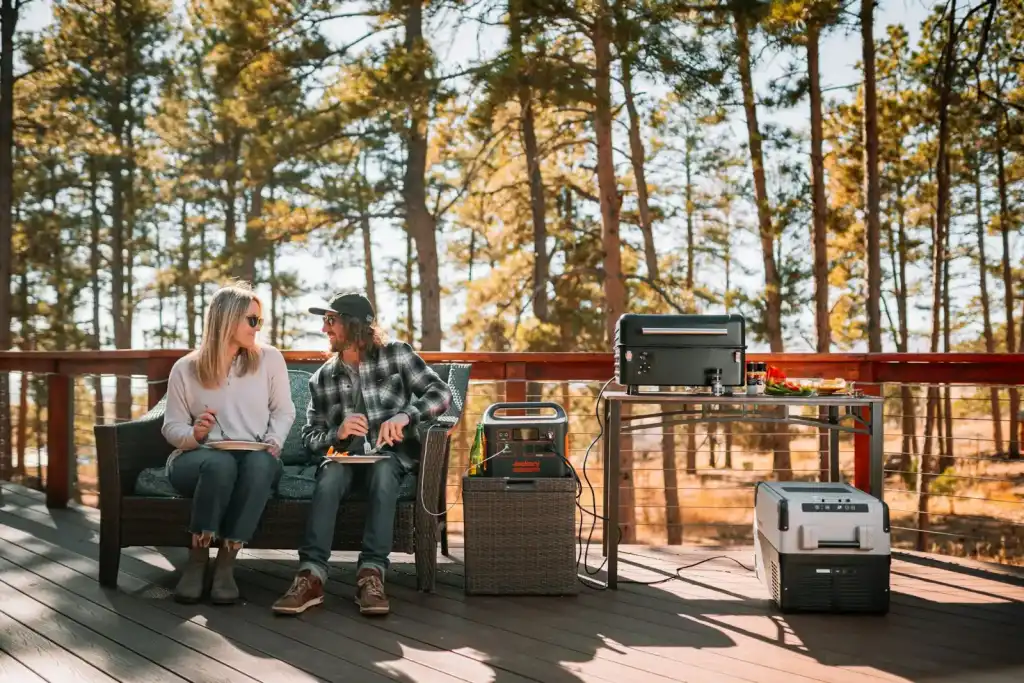
Photo: Jackery Power Station on Unsplash (Unsplash License).